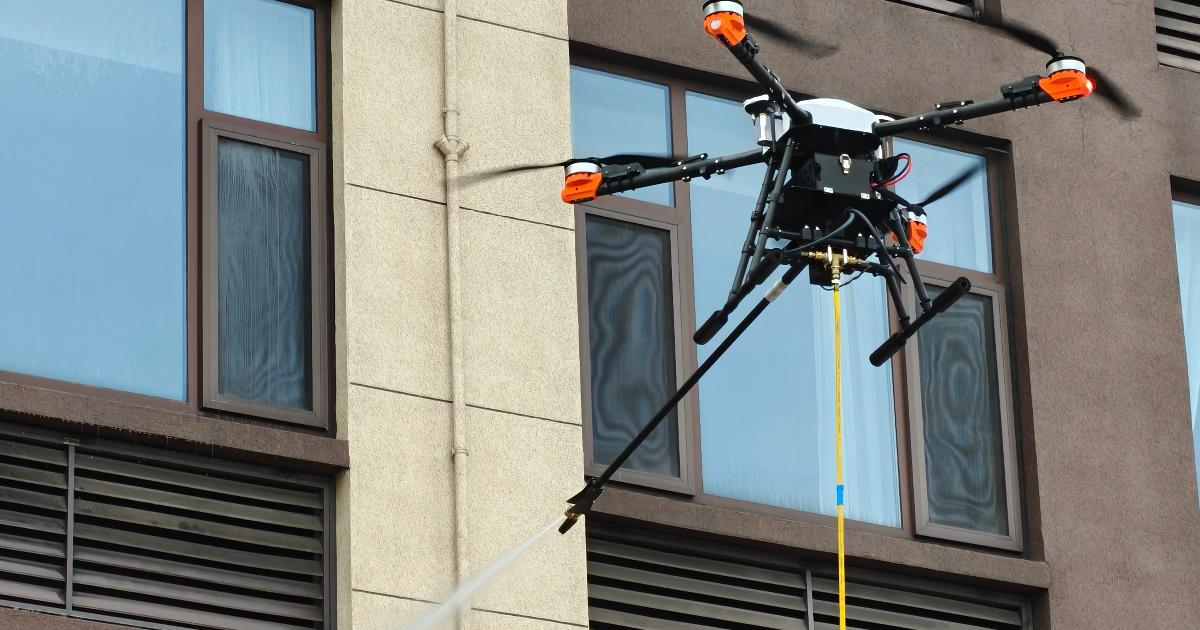
Drone cleaning is a genuinely interesting business idea. It solves a real problem — the safety, insurance, and downtime burden of working at height — with a tool that’s dramatically faster than scaffolding or rope access, and it sits behind an equipment cost high enough to keep out casual competitors but low enough for a single founder to finance. That combination is why the pitch is compelling. It is also exactly why the pitch is easy to mistake for a guarantee. A good value proposition on paper is not the same thing as a customer willing to sign a contract in your zip code, in your customer segment, this year. This piece is about the gap between those two things, and how to close it with observation and small experiments instead of hope.
The Value Proposition Is Real — But It’s Not Yours Automatically
Start with what’s genuinely true about drone cleaning, because the temptation with any capital-intensive idea is to swing between blind faith and dismissive skepticism, and neither serves you.
The core pitch is not "drones are cool." It’s risk transfer. Building owners and facility managers don’t wake up excited about rotors and cameras; they wake up worried about OSHA liability, insurance premiums, and the logistical headache of shutting down a site for scaffolding. A service that removes people from ladders and lifts is solving a liability problem that a facilities director already loses sleep over. That’s a different — and generally stronger — sales motion than "we’re faster" or "we’re cheaper," because risk reduction speaks to a person’s job security, not just their budget line.
The speed advantage compounds that pitch. Industry estimates put drone cleaning at up to 90% faster than scaffolding or rope access for comparable jobs, which is the kind of number that turns a multi-day site disruption into an afternoon interruption. And the equipment cost — roughly $45,000 to $65,000 for the drone itself, climbing to about $75,000 once you add ground support gear — functions less like a typical small-business startup cost and more like financing a commercial vehicle. That’s a meaningful barrier against casual operators without being so large it locks out a determined solo founder.
Market forecasts back the growth story, if not with perfect agreement. One estimate puts the global drone-based cleaning system market at roughly $4.85 billion by 2033, growing about 17% annually; another projects $5.17 billion by 2034 at close to 16.9%. The two numbers are close enough to trust the direction — the category is expanding — but different enough in their assumptions that neither should be treated as a precise prediction for your city, your building type, or your first two years in business. Growth at the category level and demand in your specific market are related but not the same claim, and that distinction is the entire subject of this article.
Why "The Market Is Growing" Isn’t the Same as "My Customer Will Buy"
Here’s where founders most often skip a step. They read that commercial cleaning bids increasingly request drone service, or that incumbent window-cleaning companies are buying drones just to avoid losing contracts, and they extrapolate: if the market wants this everywhere, it must want it here. But drone cleaning customers are not one audience with one motivation.
Commercial building owners — offices, hotels, retail — care about safety, efficiency, and how a clean facade reflects on their brand, and they’re moderately price-sensitive: they’ll pay for reliability but won’t automatically pay a premium for a drone versus a truck. Industrial clients — refineries, power plants, manufacturing — care first about worker safety and regulatory compliance, and downtime avoidance matters more to them than price, because an incident or an outage costs far more than a cleaning invoice. Infrastructure and public-sector buyers — bridges, dams, stadiums, wind turbines — often procure through tenders where "cheapest compliant bid" can beat "best technology," even if your drone is objectively superior. Luxury residential clients care about discretion and finish quality and are the least price-sensitive of the group, but they’re also the smallest and least repeatable segment.
None of that variation shows up if you only read the industry-level growth numbers. It shows up when you talk to people. This is the part of validating a capital-intensive idea that gets skipped most often, not because it’s hard, but because it’s slower and less exciting than researching drone specs.
Demand Experiments: Small Tests Before the Big Spend
The good news is that testing demand for drone cleaning doesn’t require a drone. It requires structured conversations, a little strategic pricing, and a willingness to hear "no" clearly enough that you don’t talk yourself out of hearing it.
Start with interviews, not pitches. The instinct when you’re excited about an idea is to explain it to people and watch their faces light up. Resist that. An interview that reveals real demand is one where you ask about the problem before you mention the solution. Ask a property manager how they currently handle exterior cleaning, how often it happens, what it costs, and what goes wrong. If they immediately mention scaffolding permits, site shutdowns, or a recent safety scare, you’ve found someone whose pain matches your pitch. If they shrug and say cleaning "isn’t really a priority," you’ve learned something just as valuable — that this particular building, in this particular market, may not be your customer yet, regardless of how the drone works.
The segments matter here, because a question that reveals real interest from an industrial plant manager can produce nothing but polite nodding from a hotel operations director, and vice versa. Below is a starting set of questions organized by segment and mapped to the value proposition each is most likely to respond to.
| Customer Segment | What They Value Most | Question That Tests Real Demand | Answer That Signals Polite Interest, Not a Sale |
|---|---|---|---|
| Commercial (offices, hotels, retail) | Safety, efficiency, brand image | "When was your last exterior cleaning incident or near-miss, and what did the shutdown cost you in disruption?" | "We haven’t had issues, but drones sound cool" |
| Industrial (plants, refineries, utilities) | Worker safety, regulatory compliance, uptime | "Walk me through your current process for approving height work — who signs off, and what’s the compliance paperwork?" | "We’d need corporate approval eventually" with no specific process named |
| Infrastructure & public works | Compliance, cost-effectiveness in tenders | "How is your next maintenance contract being procured — sole-source, or open tender — and what’s the evaluation criteria?" | "We’re always looking at new vendors" with no upcoming tender mentioned |
| Residential luxury / HOA | Discretion, finish quality | "What’s stopped you from hiring a specialist for your hardest-to-reach surfaces so far?" | "We just haven’t gotten around to it" |
| Existing pressure-washing contractors | Subcontracting height work they can’t do | "How often do you turn down or lose a bid because of height-access requirements?" | "Not often, we usually just rent a lift" |
The value of this kind of table isn’t the questions themselves — it’s the discipline of separating a segment’s stated priority from evidence that they’ve already acted on it. A facilities director who names a specific incident, a specific budget line, or a specific procurement timeline is telling you something concrete. A facilities director who agrees the idea "makes sense" while offering nothing specific is being polite, which costs them nothing and tells you nothing.
Price the Idea Before You Buy the Drone
Once you’ve had several of these conversations, test a number. Not a formal quote — a range. Ask what they currently spend on exterior cleaning and what they’d expect to pay for a drone-based alternative that’s faster and eliminates scaffolding. You’re not looking for a binding commitment; you’re looking for whether the number they volunteer is close enough to what the economics of a $75,000 piece of equipment actually require. If everyone you talk to assumes drone cleaning should cost less than what they already pay a pressure-washing crew, that’s a signal worth taking seriously before you finance anything — not because their assumption is necessarily correct, but because changing that assumption is a sales problem you’ll need a plan for, not something the technology solves by existing.
The Discounted Pilot Job — and What It Actually Proves
The most tempting shortcut in this whole process is landing one paying job and treating it as proof the business works. Be careful here. A single job — especially one priced to win, scoped generously, or won because the usual vendor was unavailable that month — proves that a market can exist, not that it does, reliably, at a price that supports your margins.
A more honest test is to offer a small number of jobs at a deliberately discounted rate specifically to observe behavior, not just to collect a check. What you’re watching for is repeat intent: does the same client rebook without you chasing them? Do they refer you to a peer unprompted? Does the relationship convert into the kind of longer-term contract that, as market data on the sector suggests, providers increasingly rely on to make the capital cost of drones sustainable, since gross margins in the 40–60% range on high-value contracts get eroded quickly by drone maintenance, insurance, pilot training, and cleaning-agent costs if the work isn’t recurring. A discounted job that generates a referral and a signed maintenance schedule is a much stronger signal than a discounted job that ends with a thank-you and silence.
Watch for the three false positives that trip up first-time founders most often: the client who only called you because their regular vendor was booked and will go right back to them next quarter; the one-off high-value job that isn’t representative of what most of your prospects will actually pay; and the property owner who was genuinely impressed watching the drone fly but has no line item in next year’s budget for the work, however much they enjoyed the demonstration.
What Regulation and Equipment Don’t Settle for You
Part of what makes drone cleaning feel low-risk is that the regulatory bar is unusually low for a commercial aviation activity. The FAA Part 107 Remote Pilot Certificate is a knowledge exam, not a flight test, and most applicants pass it after a few weeks of self-study. That’s genuinely reassuring — it means the barrier to legally operating is administrative, not a years-long apprenticeship. But it’s worth being precise about what that clears you for: the right to fly commercially. It says nothing about whether a facilities director in your metro area is ready to switch vendors, or whether your market already has three operators competing for the same handful of contracts.
The same caution applies to training. Manufacturers vary widely in what they include — some bundle hands-on operator training into the purchase price, others charge per seat, and at least one popular platform includes no training and no U.S. spray-system support at all. Comparing programs is worth doing carefully, but there’s no available evidence that a more elaborate training program translates into stronger margins or happier customers — it’s reasonable to assume better preparation helps, but treat that as an assumption to test on the job, not a fact to bank on.
Borrowing Numbers You Don’t Actually Have
One more habit worth resisting: pulling customer-acquisition-cost or sales-cycle benchmarks from an unrelated industry and applying them to your drone business as if they transfer directly. SaaS companies, for instance, talk about CAC ranging from under a hundred dollars for self-serve products to several thousand for enterprise deals, with payback periods tracked in months. That’s a useful framework — the idea that you should know what it costs you to win a customer and how long it takes to recover that cost is a sound discipline for any business, including yours. But the actual numbers from software sales tell you nothing reliable about how long it takes a facilities director to approve a drone-cleaning vendor, because the buyer, the budget cycle, and the risk calculus are entirely different. The right move isn’t to import someone else’s benchmark — it’s to start tracking your own, from the very first interview onward, so that by the time you’re ready to buy equipment you have real numbers from your own funnel instead of borrowed ones.
The Bottom Line
The tank that took ten days by scaffolding and an afternoon by drone is a real and compelling story about what the technology can do. It is not, by itself, evidence that your local market is ready to pay for it. Before the equipment purchase, the honest sequence is: talk to the specific segments you plan to serve, using questions that force specifics rather than agreement; test pricing assumptions out loud; and if you can, run a handful of discounted pilot jobs designed to reveal whether interest turns into repeat business rather than a single flattering anecdote. None of that guarantees success — no experiment does. But it will tell you, for a fraction of $75,000, whether you’re looking at a genuine local opportunity or a well-told story that happens to be true somewhere else.